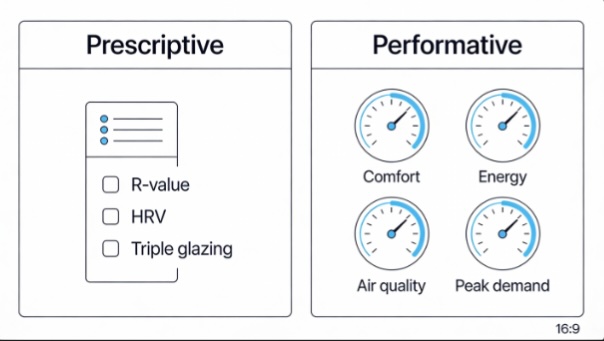
What is performative design, as opposed to prescriptive design, and what are the consequences of differentiating these two approaches and building accordingly? Quite simply, prescriptive design is when you assemble a laundry list of desirables and then build that list. The list is the prescription for a good design, and hopefully, a good building.
Performative design, with high‑performance construction as its corollary, is when your design is required to meet tangible and measurable performance criteria. The return on your investment, so to speak, can be validated in the same way you track the performance of your retirement portfolio.
When you hire a designer or an architect, and in turn a builder, for your project, the only mandatory standard the design and construction have to meet is the minimum standard set by the building code. Beyond that minimum, you are in a wild frontier of choices, trade‑offs, and marketing claims.
The prescriptive designer’s list vs. “abstractions rendered as deliverables“
Why minimum code isn’t enough
Establishing a coherent and science‑based standard is not particularly easy. It requires the participation of a number of stakeholders, not the least of which are product manufacturers, installers, testing laboratories, the establishment of accepted conventions, metrics, procedures, follow‑up and accreditation. At the very foundation is an understanding of the purpose and benefit of this entire commitment—in other words, the “why”.
No one questions the building code. The why is public safety. To go beyond public safety one has to buy into “public good” arguments, if not economic arguments. As with any means/ends discussion, things always get bogged down when there are competing ends.
Efficiency is merely the distance between the means and its end. Without evaluating the end—its objective function—efficiency remains an empty concept and is useless in the discussion of means, unless one has agreed on the end itself.
This is easily understood if one considers a “checklist” approach to sustainability or even “high performance” as a vague qualifier. Imagine your architect argues strongly for providing showers in a commercial project to encourage employees to use their bicycles to get to work. You, the client, push back until the city waives its parking requirement for the project and allows a larger footprint in return for secure bicycle “storage”. The city wants to appear pro‑environment and ease congestion. You want a larger rentable area and your architect argues for “good” design as if it can exist as an end in itself. Regardless of respective points of view, reducing parking and adding showers does not add a whole lot of cost in the scheme of things and has tangible benefits so … yes … win‑win all around.
Efficiency is only meaningful once we agree on the end: comfort, health, resilience, emissions, cost—or some mix of all five.
When checklists fail… the HRV example
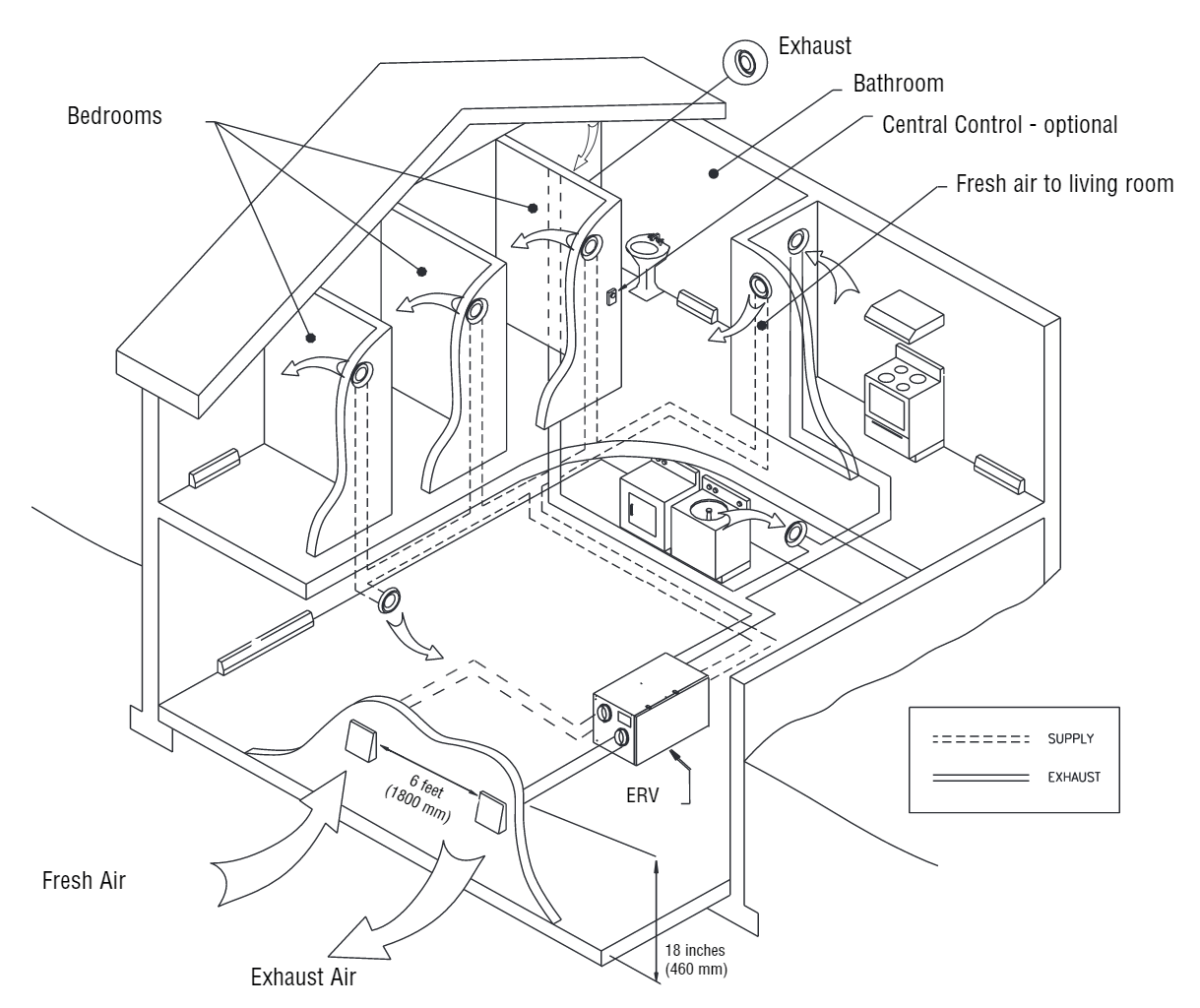
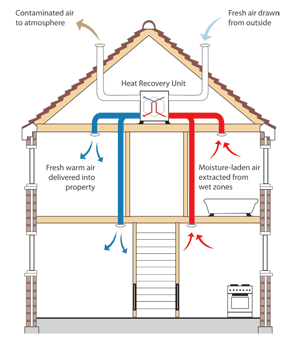
But let’s take another example. The building code cares about air quality and demands a certain amount of air must be exhausted from the building at a specified rate based on occupancy and use. Air should be replaced at the same rate for the NBC (National Building Code) and ASHRAE standard to be met. A checklist‑based approach to energy efficiency would call for an HRV or ERV system in order to reclaim the energy being pushed out of the building during the heating season and being brought into the building during the cooling season. At first glance, not a bad prescription given the obvious benefits of such an investment.
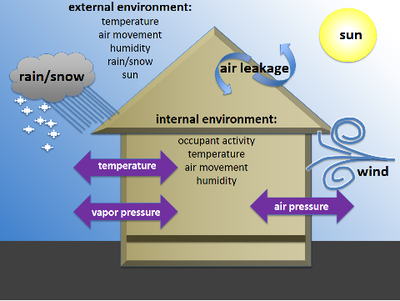
The HRV is not mandated by the building code. It makes sense, however, given the code’s requirement to expel “warmed” or “cooled” air—air that has already been invested with “conditioning”. But the building code also does not mandate counteracting, never mind measuring, the rate of air leaking unintentionally through the building envelope.
Having an HRV system when your envelope leaks is no different than running the air conditioner in your car with the windows wide open. It still works, but it does not really work in any meaningful sense. Standard construction plus an HRV system is not a colossal waste of money, but neither is it a good investment.
What turns the investment into a game changer is, first, a construction detail aimed at thwarting air leakage, and an installation that is as fastidious about implementing that detail as it is about preserving the contract profit margin. Then, an installation inspection and follow‑up validation test can rate the performance and calculate what volume of air is actually being changed, and what percentage of that air is passing through the HRV (which could actually achieve 95+% efficiency).
The HRV example illustrates why performative design begins with a performance framework rather than adding technologies as an afterthought. In other words, key to the success of any prescription is the framework within which to validate the performance. Performative construction simply begins with that framework, rather than guessing—and hoping—you have a good design.
What are the necessary criteria for the Framework?
Annual energy use under normal loads
How much energy will this building consume under normal operating loads?
This is much more than knowing the thickness of insulation in the walls. Without delving into the numbers just yet, suffice to say, all of the different conditions—from macro and micro‑climate and on‑site shading and orientation conditions, to manufactured product quality and installation—all factor in every single instance within the building. Thus every thermal bridge, whether point or linear, repeated or unique, must be evaluated and factored over the year.
For a cold‑climate, Montréal‑type context, rule‑of‑thumb effective R‑values might look like:
Above‑grade walls: Aim for effective R‑40 to R‑50 (about U 0.14–0.11 W/m²·K), typically double‑stud or exterior insulated assemblies.
Roof/ceiling: Aim for effective R‑60 to R‑80 (about U 0.095–0.07 W/m²·K), usually deep attic insulation or joists/SIPs thickened with exterior insulation.
Basement walls: Aim for effective R‑25 to R‑30 (about U 0.23–0.19 W/m²·K) to the interior face of concrete, often with exterior insulation to keep the wall warm.
Under‑slab: Aim for R‑20 to R‑30 below heated slabs in contact with soil.
The net result, for the space heating demand, is that you should not be exceeding about 15 kWh/m²·year.
Why this number? In this performance range, construction is so good that, under normal operating conditions, increasing investment in the building envelope provides no meaningful change in energy consumption. In other words, the energy being used has plateaued for practical purposes, and your construction is, for all intents and purposes, “highly performative”.
Airtightness and verification
To achieve the above, in addition to adequate insulation and isolation of thermal bridging, one must also achieve adequate airtightness. This is validated with a blower‑door test.
Airtightness: blower‑door test result n50 ≤ 0.6 air changes per hour at ±50 Pa.
n50 = 0.6 ACH
Peak demand and systems sizing
Peak demand
Peak‑demand: how much energy will be required in peak moments of extreme weather?
As above, each unique instance of heat gain or loss must be evaluated, except here it is to identify not the quantity of energy over time, but the threshold amount at any given instance. The limit should never be more than 10 W/m² (the point at which the limiting condition becomes a distribution issue). For a ~150–200 m² envelope in the climate where I am (Montréal, QC), you should be in the range of 3–6 kW peak heating capacity total (e.g., small air‑source heat pump, electric resistance backup, or small hydronic coil).
Ventilation and distribution
Ventilation: one central HRV/ERV sized around 0.3–0.4 air changes per hour at normal operation, with ≥ 75–80% sensible heat recovery and low fan power (around 0.3–0.4 Wh/m³).
Distribution: with the loads as low as this, simple systems work: one small ducted heat pump tied into the ventilation, panel radiators with a tiny boiler, or point heaters plus ventilation mixing.
DHW: heat‑pump water heater or high‑efficiency boiler/heat pump with good distribution (short runs, manifolds, recirc controls) to keep primary energy down.
Primary energy and context
As mentioned, this article is written very much from a Montréal perspective—namely a predominantly cold climate with cheap, carbon‑neutral electricity. This is hardly the usual circumstance for most builders or consumers.
Thus the numbers above should also account for primary energy, whether on‑site or off, and what specifically that primary source is when power is provided by a utility. Beyond just heating and cooling loads, the power requirements of the project should answer to water and occupant energy use, where the total primary energy demand should stay under roughly 120 kWh/m²·year. This reflects the kind of comprehensive energy budgeting that distinguishes truly performative frameworks from heating‑centric prescriptive ones.
Where the numbers lead
Ironically, the numbers are not the goal of considering construction from a performative framework. Nor is it about efficiency per se. These numbers do no more than establish an objective standard of comfort and indoor environmental air quality.
If you build successfully to these standards, no interior surface or space will ever drop below about 16 ºC during the heating season. There will be no condensation leading to mold, no drafts or uncomfortable areas of a room, and no stratification of air due to temperature differentials. There is no need for baseboard heaters below windows or other prime room real estate sacrificed to counteract drafts from glazing. Oxygen and CO₂ levels remain consistent with fresh outdoor air in those spaces traditionally prone to elevated CO₂ levels and crucial to proper sleep or proper mental concentration.
This should be the standard where one begins, not arrives. In other words, performative frameworks for design, and their execution and validation in construction, do not tell us what to build or how to build. They merely provide the key metrics to meet in order to achieve a baseline of physical comfort and healthy indoor air quality much as the current building code establishes a baseline for public safety.
The real payback in beginning with the framework is the resilience and durability of the construction invested in from the beginning.
n50 = 0.6 ACH